
This is going to be a very sew-y post. Non-seamsters have been warned!

Vintage Vines tote
My last long-handled tote bag sold out in December, and I’ve been wanting to make more ever since. I know how handy these bags are — I use one myself — but I don’t always have enough big pieces of fabric on hand (which is how I ended up making a lot of short-handled bags instead). Recently I finally got around to washing some of my vintage finds, so yesterday I decided to make a tote from a tutorial that seemed to be an improvement on my design.
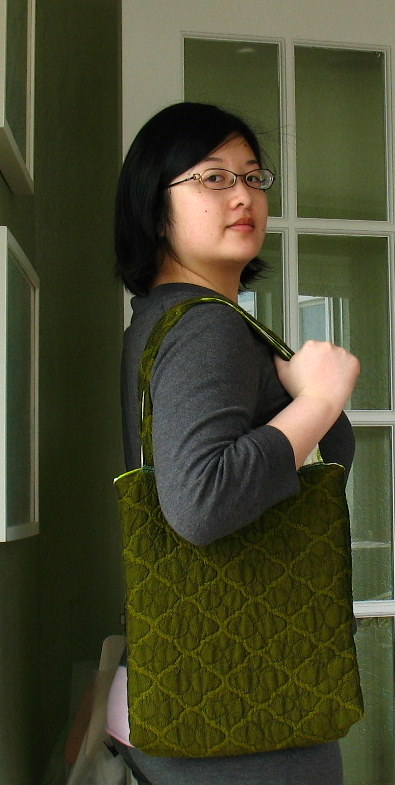
Such a nice squishy shoulder bag.
The tutorial makes the process look very simple, but I soon realized my project wouldn’t be done nearly as quickly as hers. For one thing, I wanted to use both fabrics in the strap, so I couldn’t use her time-saving method for folding the strap fabric. But the biggest trouble was that the olive green fabric was stretchy — really quite stretchy, in fact. I had been hugging and squeezing that fabric since I bought it months ago, and somehow I’d never noticed the stretch; I guess because it was a thick, quilted fabric I just figured it wouldn’t stretch. Perfect example of how our preconceptions override our observations! I saw the stretch when I was cutting the fabric, but I really noticed it when I started stitching the straps. Oops. Luckily it came out okay on the strap, but I could see that the body of the bag would never reverse properly unless I found some way to combat the stretch in the olive fabric.
About a month ago I bought two fusible interfacings from Jo-Ann: one heavy-duty, one super-sheer, both double-sided. (I wanted other weights too, but Jo-Ann’s selection is very limited. Boo.) My first thought was that I could fuse the heavyweight interfacing to the olive green fabric, and it would both take care of the stretch problem and make the bag sturdier. I cut a square from the scrap fabric and tried it, and it failed miserably; I think the quilted reverse side of the fabric made it hard for the adhesive to fuse. Or maybe I did it wrong. I don’t know, but it was never going to work. Then it occurred to me that maybe just using the sheer-weight interfacing over the seam areas would be enough; after all, I didn’t mind if the bag stretched, I just couldn’t have the fabric stretching when I sewed it together. So I cut strips of that interfacing and fused it to the sides of the bag (the horizontal stretch wasn’t as bad, so I only did the sides). But because the interfacing is double-sided, it was a little sticky on the unfused side, and I was afraid that it would gum up my machine if I ran it through like that. So I fused some scrap unbleached muslin to the other side… and then realized I’d basically made my own lightweight interfacing. I don’t know if sewists typically use interfacing to help in stitching stretchy fabrics, but it worked beautifully for me, and I was very proud of myself for figuring it out!
I continued using the tutorial guidelines to stitch the body of the bag, and mostly that went fine. The olive green fabric caused me some more problems when it came to doing the corners (to make the bag sit flat); it’s very thick, and my homemade interfacing made it even harder to manipulate, so the corners came out uneven. I wanted to redo them but the way the fabric is woven on the back side, it was nearly impossible to see my stitches to pick them out. So I was forced to leave the corners as they were (it was that, or lose my sanity and the rest of my evening cursing at the seam ripper!).
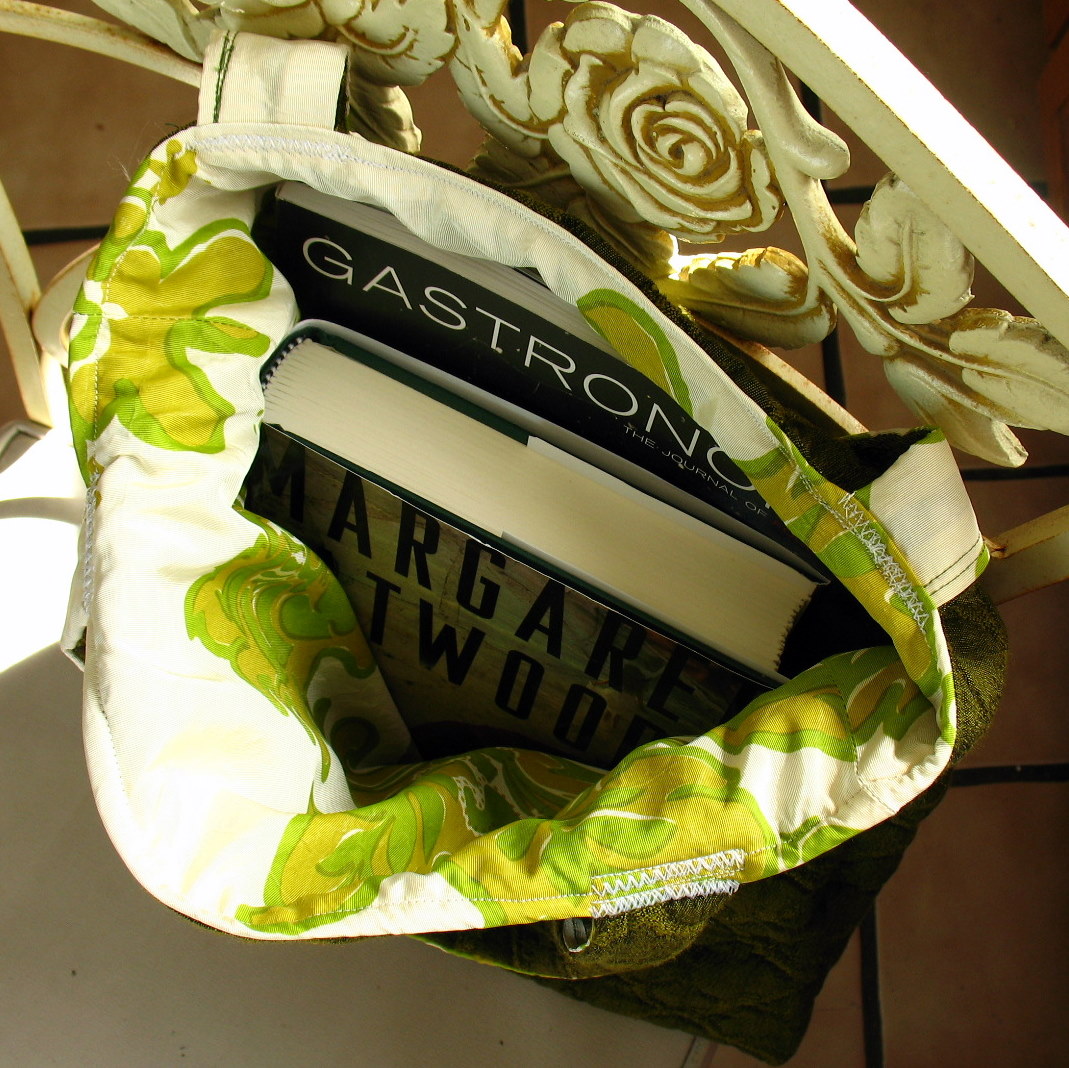
I SO adore these vintage fabrics.
Then, I ran into another big problem with the straps. Actually there are two problems, and one is my fault, and one is due to the tutorial-maker’s bag design. The mistake I made was not being careful enough when positioning the straps, so that I sewed them a little less securely than I should have. But the design flaw is that the straps are only held on to the bag body with one line of stitching (and I, being three-dimensional-visualization-ally challenged, didn’t realize this until after the bag was made), which I would never want in one of my bags, whether I used it myself, gave it as a gift, or sold it to a stranger. If you look at the top photo here, you’ll see that I always attach my straps with a double-stitched X inside of a box; I do this even on non-weight-bearing items like my cash aprons. I don’t know if the pattern helps distribute the weight better or anything scientific like that, but at the very least, that’s two layers of six lines of stitching holding each strap end to the main piece. You couldn’t rip that out if you tried. To be honest, it’d be pretty hard to rip out even just one line of stitches too, which is I guess what the tutorial maker is counting on with her design. But I carry a lot of stuff in my bags and I put them through a lot of hard use, so I just wouldn’t feel right not reinforcing the strap attachment. I tried to do it a little bit on this bag, but it’s still not to my liking, and now it looks not-so-cute.
So… what am I going to do with this bag? As I say, it’s uneven, the strap stitching is cosmetically challenged, and the straps aren’t attached as securely as I like. But it’s also made of a unique combination of two lovely vintage fabrics, and it’s extremely comfortable and cushy; when I was carrying it around this morning modeling it, it just felt really good on my shoulder and in my hands. Nevertheless… I think it’s going to have to go into the “imperfects” stash I told you about yesterday. Or I will give in and keep it for myself, because I love it just that much. 🙂
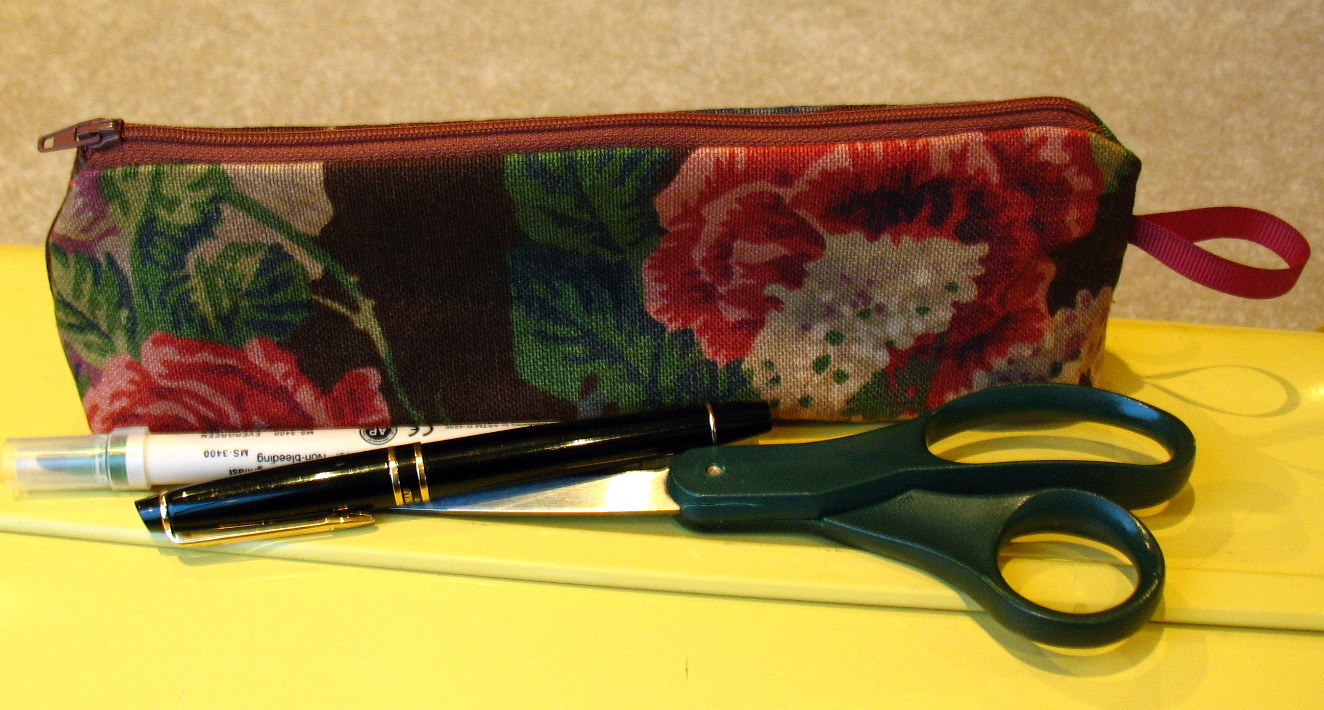
Chocolate Rose pencil pouch
Many months ago, my friend Tamara asked me to make a replacement for her beloved aging pencil pouch. I gladly agreed, especially since she said she was in no hurry. I’d been wanting to learn zippers for quite a while, and I figured the pouch would be a pleasant light challenge. Well, as regular readers will know, zippered pouches have proven much more difficult than I anticipated! My machine has a very low zipper foot, so I can’t use thick fabrics, and it’s always a little tricky trying to get the zipper positioned just right. But after making one successful pouch a couple of weeks ago, I figured it was time to give the pencil pouch a try. I knew the general dimensions of the pouch, but I wasn’t exactly sure how to do the bottom, so I selected some easy fabrics for a mock-up.
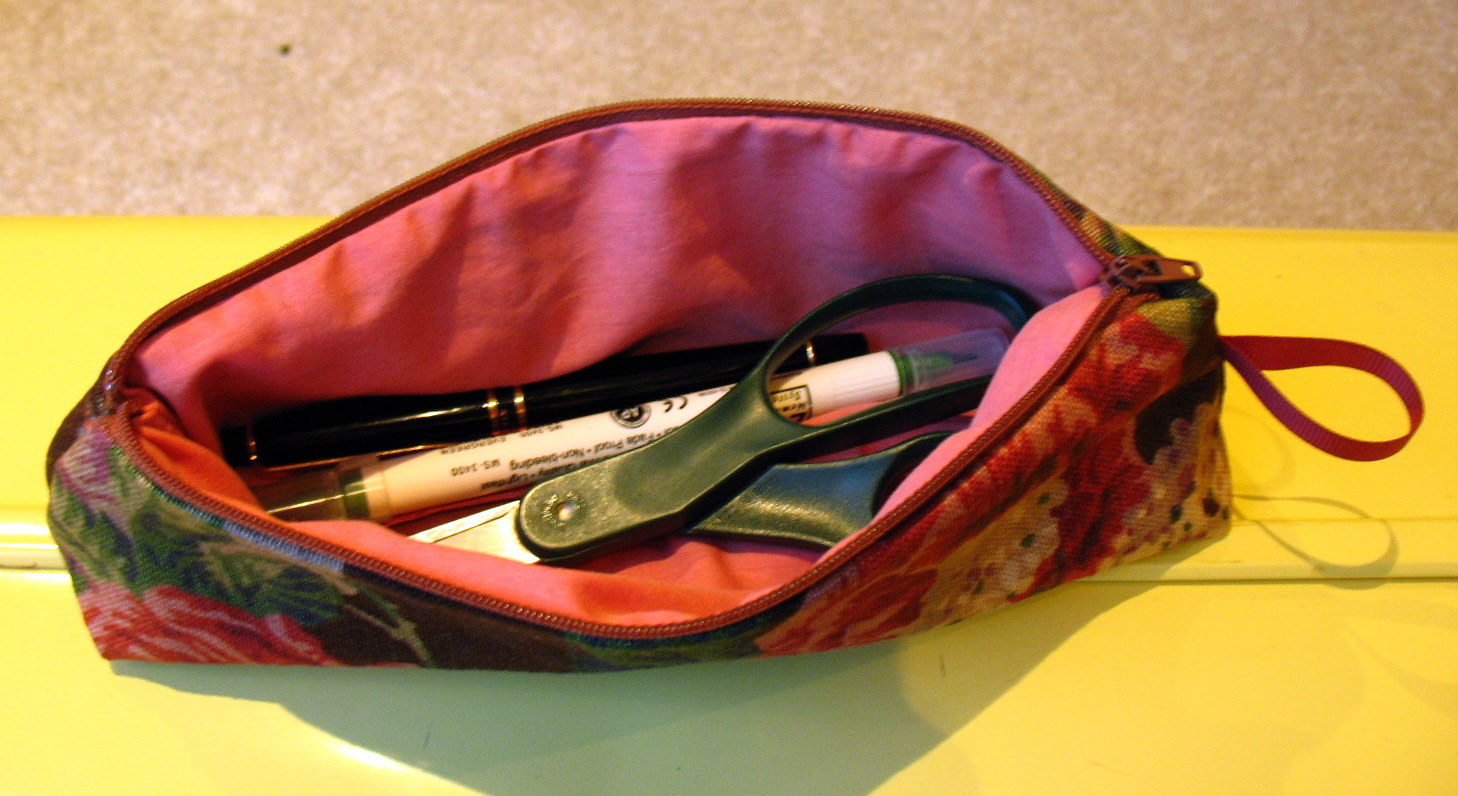
That yummy lining fabric comes from a thrifted pillowcase!
The pouch started easily enough. I had to go back to the tutorial for the zipper positioning, but to my happy surprise, the zipper foot didn’t give me any trouble. No… this time the trouble came from the thread tension, and I didn’t realize for a long time that that was what it was. Every time I tried to sew, I got an ungodly mess on the back side of the seam (something like this), and before long my needle would get stuck and the machine would make that dreadful “EHHH” noise that strikes fear into my heart every time (that noise has meant broken needles, more than once). I’ve never had this problem before, so I didn’t know what it was, and I just kept sewing and thinking it would go away on its own. Eventually I looked at my machine manual, and though it’s often unhelpful, this time the troubleshooting page listed exactly this problem and exactly the right fix for it. I upped my thread tension, and voilà, the problem vanished like magic: my seams were once again straight, even, and true. Wow. Let that be a lesson to me to never again forget to adjust my thread tension!
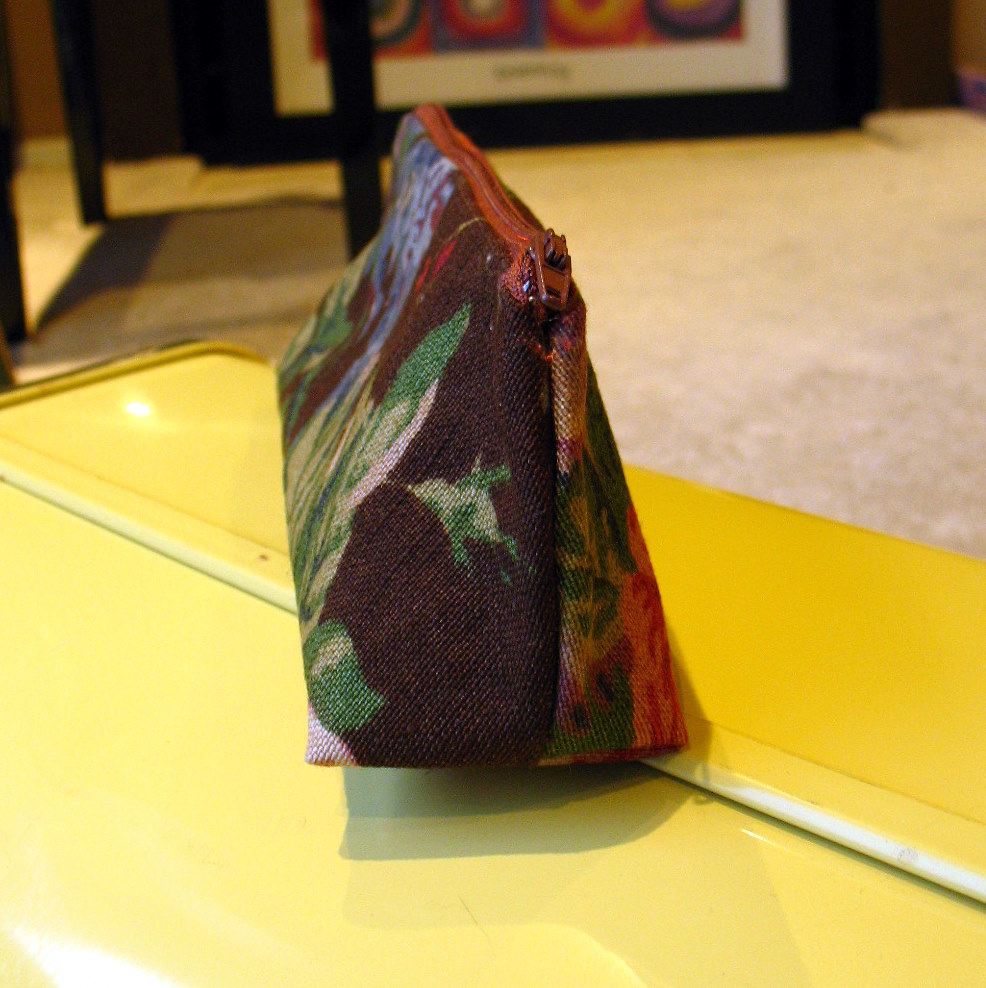
Triangular prism, oh yeah.
To cut the drama short, the tension issue was about as bad as it got with this project. I’d successfully calculated the angle to make the pouch have this cool flat-bottomed triangular prism shape, but I did get a little confused by how to make the bottom more rigid. Tamara told me her old pouch had a piece of plastic in it, which served the purpose well, but the plastic had started to poke out of the fabric as the bag saw more use. I thought I would turn to that heavy-duty interfacing again, so I fused mediumweight fabrics to both sides of a strip of interfacing, and inserted it between the exterior and the lining. But it buckled a bit, because it wasn’t attached, so I tried stitching it to the “tabs” created by the inside corner stitching I did to make that flat-bottomed shape (if you’ve done this before, you’ll know what I mean; otherwise, see photo #4 here). That helped, but it still didn’t do the trick. So I will have to think of something else for my next attempt.
I’m pretty happy with this pouch overall, and I think it’s a good start on getting Tamara’s pouch design exactly the way we want it. This pouch isn’t quite big enough for her specifications, but that’ll be a fairly easy fix. Tamara, if you’re reading this, hope this keeps you excited about your forthcoming pouch! And thank you so much for your patience with the delay. 🙂
As for this pouch, it’ll go into the sample sale inventory too. I’m building up quite a stock here! 😉
 satsumabug.com | Lisa Hsia
yaaaaay pencil pouch! 😀
I love shoulder bags and pencil pouches like that. Is it quilted? You could make a killing doing laptop cases.
It’s not quilted, but I’ve been thinking about experimenting with quilting at some point. Good thought on the laptop cases! I made one for my brother-in-law before I learned to do zippers, but now I can make much cooler ones. 😀