
What a long day. It does feel like a Sunday; the weather was beautiful today and we spent much of the day out. But I’m also as exhausted as if I’d had a full work day, which I guess I sort of have. I’m thankful I didn’t have any other plans for the evening, so I can spend it resting properly and doing only quiet activities!
Drawing marathon
At 9 this morning Erik and I left for the drawing marathon, which proved to be at a community college set in a fantastically beautiful location in the Oakland hills. When we got there, half an hour early, there was already a long line out the door, as marathon regulars queued up early to nab their favorite spots. We paid our $30 apiece, walked a few feet into the room, and then stopped, totally overwhelmed. Normally one goes into drawing class and there’s one model standing on a platform in the center of the room, and a few students scattered around the perimeter. Today there were four large platforms and at least ten models, and artists, paint boxes, papers, canvases, easels, drawing horses, and chairs everywhere. The early comers had all staked out their spots already, and we had to wend in and out between them and their equipment as we hunted a place for ourselves. I maneuvered my fat backpack, and Erik our drawing board and pads, as carefully but quickly as possible. People were greeting each other, robed models stood about eating and drinking, and every time we moved a limb we ran the risk of knocking easels over. We heard glass shatter, and soon saw a woman sweeping up the shards and shouting, “Models, keep your shoes on!” In the end we found a spot and had just enough time to set up and make a quick bathroom run before the poses began.
As it turned out, we’d chosen a good spot. We hadn’t realized when we came in that the models’ 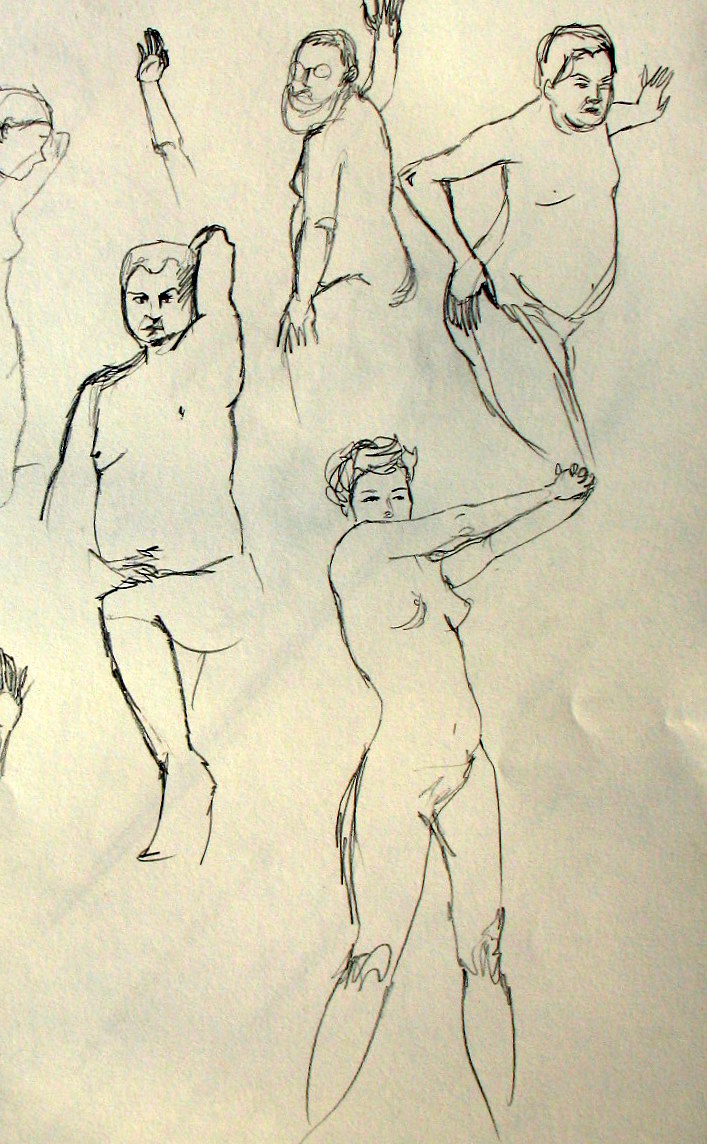 platforms were organized by pose length, but luckily we’d situated ourselves with a good view of three of the platforms. I could draw easily from both the 20-minute platform and the 1- and 2-minute platform, while Erik could swivel around to do either of these or the 10-minute platform. Every 20 minutes, we’d take a break, and then the models would rotate to a different platform. It worked well: the models got a chance to alternate between shorter and longer poses, and the artists got to draw different models and angles each time. At least that’s the way it mostly worked; over in an alcove on the other side of the room, a beautifully vintage-costumed model did the same pose for the full morning session, giving oil and acrylic painters enough time to make substantive portraits.
Usually, in classes, we start with quick poses (1 or 2 minutes) for warm-up and gesture drawings. I like these because the models can do weirder or more dynamic poses, since they only have to hold each one for a minute or two. Today, though, I didn’t realize the 1s and 2s were even there until halfway through the session, so the above sketches were done after I’d warmed up on 20-minute poses. I enjoyed these three models. It’s funny; I don’t have a lot of practice drawing men, and here I found myself most drawn to the men with ample flesh — the ones with curves and squishy parts, the ones whose body composition more closely resembled that of women. All the lean, angular, muscular men were a real challenge for me; I’m not even posting those sketches, because I had such a hard time with them, they don’t look like anything. I also drew these guys first thing in the morning, so they were my warm-up, and my warm-up sketches are rarely good.
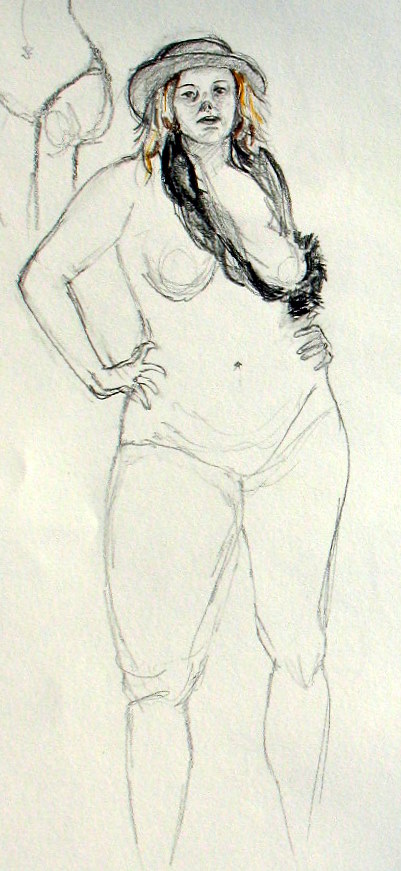 Another thing I’ve noticed since I started crafting is that I do particularly well with models who use textiles as props. When I’ve been doing a series of not-so-hot sketches, and I’m feeling cranky and down on my ability, if the model pulls out a piece of cloth, I’m suddenly all inspired again. I look at the page and I know just where to start, all the lines and proportions flow, and I even manage to capture the model’s attitude much more vividly. When I drew the sketch at left, I was coming off several poses of angular men and one of a lithe, beautiful girl, and none of them had worked and I was feeling very cross and wondering whether the whole morning was going to be a wash. Then this fabulous model stepped onto the platform, filling it with her presence, and whipped out this piece of black gauze and a black velvet hat, and I was off and running. I wish I hadn’t had to cut off her feet, but I couldn’t see them; another model was lying down in front of them (and I couldn’t draw her, though I wanted to, because other artists were in my way).
I have to say, I am a bit disappointed that I didn’t get much practice with the 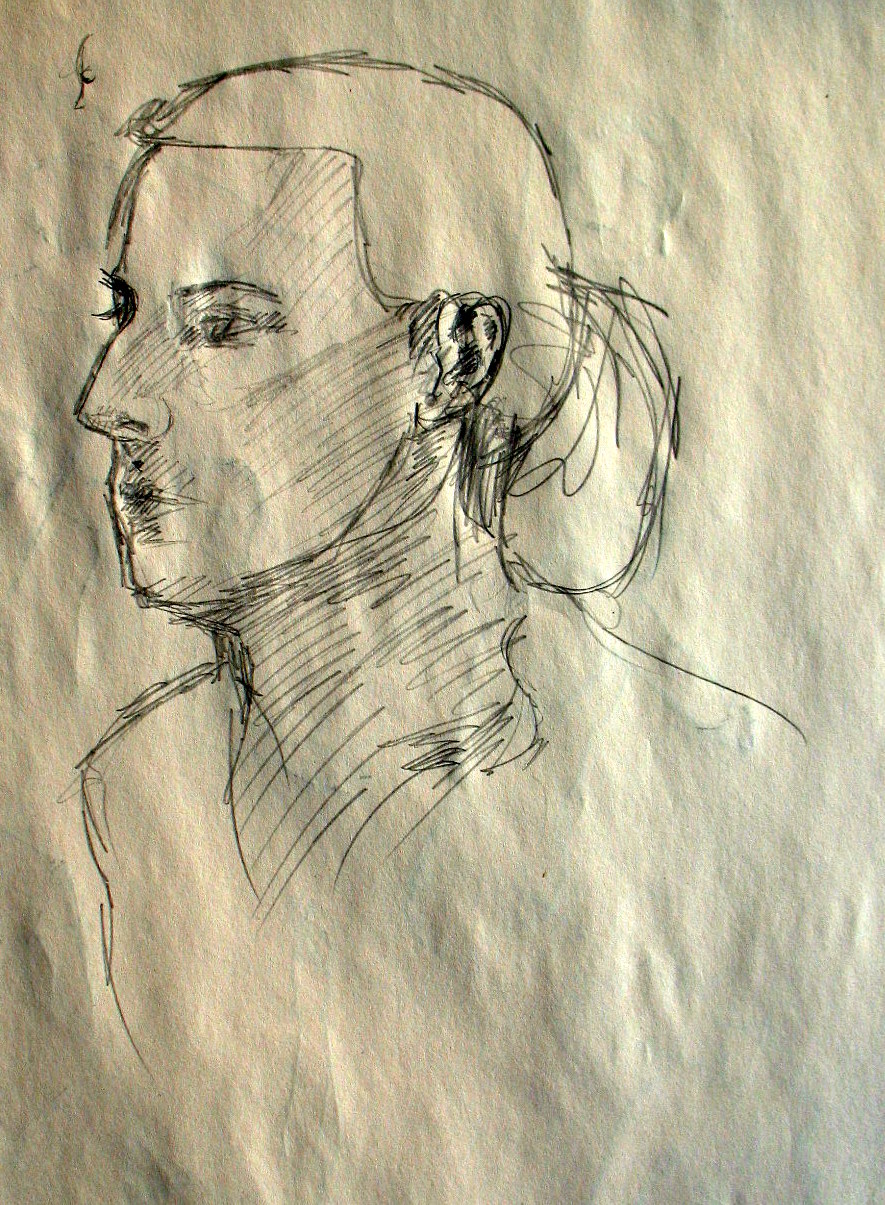 nonwhite models who were there today. As a person of color myself (I kind of hate that phrase, but it’s so serviceable I use it anyway), I value opportunities to have others like me to serve as models and inspiration, just to counteract all that perfect whiteness we see in magazines and on film and TV. On the other hand, those magazine photos aren’t just of white women but are of white women of particular proportions and features, so I guess it’s just as valuable to draw models who are larger, curvier, flatter-chested, more androgynous, or what have you — and in that sense, almost any regular human being will do, because most of us don’t look like magazine models! This is what I love so much about drawing from models in real life. Even the youngest, slimmest, and most “perfect” girls or guys will still have soft tummies and skin folds — and usually messy hair and dark circles under their eyes, to boot. And every body is so different, just as every face is so different; I get to practice from reality rather than from airbrushed ideals. I have a fat file of photos saved up for drawing practice, taken from photos of models as well as normal people, but these images are just so flat (literally and figuratively) compared to the active, breathing, imperfect presence of real individuals posing just a few feet from me.
Thrift and vintage shopping
I’ve noticed that I tend to get drawing fatigue after about two and a half hours, and that held true again today. By the time the morning session was over, I was drained and ravenous. We intended to search for local eats, since we’re not often in that area of Oakland, but we found nothing, and ended up taking a hugely long roundabout way back to the highway. By the time we found ourselves near Berkeley, we were tired, dehydrated, and just this side of irritable — and we both had to pee. Luckily, we wound up at a Chinese-Korean noodle place on Telegraph, where we recharged with bathroom breaks, hot barley tea and ice cold water, poached dumplings, and enormous, slurpy servings of noodles and crunchy daikon pickles. I always want to say “best meal ever” after meals like this, but seriously — having all those basic needs met at once really is the best feeling ever. (I’m reminded notably of this entry in my personal journal, a few years back!)
After our revitalizing lunch, we wandered Telegraph for a bit, checking out the thrift 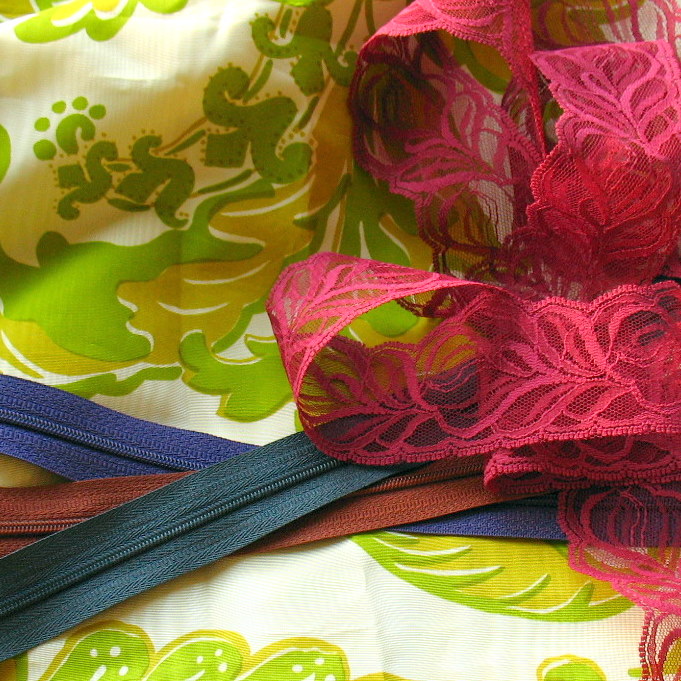 and vintage stores for possible craft supplies or display props. I gleefully wandered the aisles of the East Bay Depot for Creative Reuse, where they had seemingly everything a crafter could possibly want, from bolts of fabric to giant stashes of toilet-paper tubes. I got two yards of magenta lace, three zippers, two and a half yards of vintage taffeta, and a little bag of vintage buttons, and Erik got some great heavyweight music notation paper. I also eyed a fantastic, gargantuan vintage birdcage, but even at 50% off it was still $125. Too bad — it would have made a phenomenal display prop at Craft Happy!
 That was a fun place; I’d like to go back there sometime to look over the goods more carefully. They had tons of art and frames, stationery, papers, fabrics, and trims I didn’t want to bother to sort through, and I could use some more plant pots for the deck too.
The other places we went to after Creative Reuse were less inspiring; one place had only 80s-ish vintage clothing, and another was one of those crazy-making everything stores where there’s so much stuff one can hardly wade through it, and it spills over into back room after side wing after outdoor storage area. At least everything there was good, no cheap junk, but still, the atmosphere got to us. There was a set of dishes I liked but they’d been sitting outdoors for goodness knows how long, and when I picked up the top one, rainwater poured out onto the stack below. No harm done, I suppose… but bleh, anyway.
Textile wisdom
On our way home I texted Jinny to beg some of her extensive craft knowledge: how to clean the taffeta? She said I could take a match to a corner of it, to figure out fabric content. This turned out to be so fascinating I just had to share.
Knowing what kinds of fibers went into a textile can tell you a lot about how the textile will behave. This is not just true for fabric, but also for materials like yarn. Burning a little piece of fabric can tell you what’s in it, because most synthetics are basically plastic, and so they’ll melt in a flame, rather than burning the way a cotton candle wick does. I burned a little cotton scrap, and it made a neat, brown edge, like artistically fake-aged paper. I cut off a corner of my new taffeta, and the edge blackened, hardened, and turned glossy, like resin. I did two more scraps to share with you (click on the photo and you’ll see even more detail):
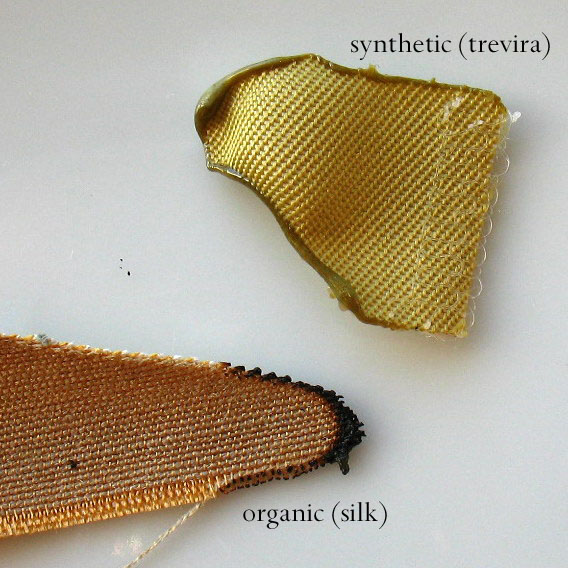 The top right fabric is Trevira, the synthetic fabric I used for my apple-green yoga tote. I love the shiny, uneven hard edge the flame created on it. (Trevira is supposed to be flame-retardant… hmm. I guess it burned kind of slowly?) The bottom left is a silk scrap from the Tierra yoga tote. The silk didn’t burn exactly the way the cotton did, but it also made a neat charred edge that I could crumble a little with my fingers.
I did a quick Google search and it turns out there are more complicated (and consequently more informative) ways of doing this burn test, but the simple snip-and-torch method worked fine for my purposes. Now I know I can throw the taffeta in the wash — and it needs it, too! — and I know how to test any future vintage finds! So exciting. I may experiment more with burning for aesthetic purposes in the future — Jinny, you’ve made a pyro of me! 🙂
That’s it for the week!
 satsumabug.com | Lisa Hsia